26 Feb 26 – India Postal Stationery
Very rare Indian postal stationery by Sandeep Jaiswal FRPSL
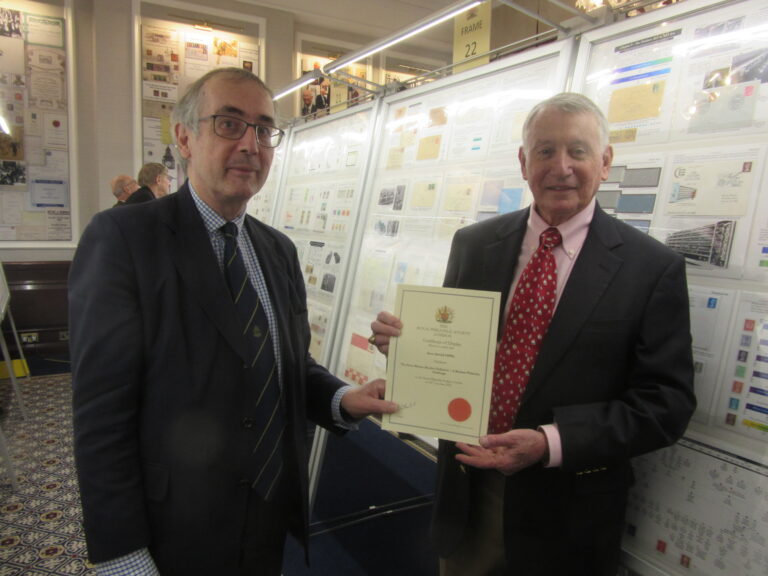
‘The material on show was very rare, with most items never seen before by members.’ This was the introduction from Simon Richards, RDP, FRPSL, President of the Royal Philatelic Society London, to the display of Indian Postal Stationery given to the Society by Sandeep Jaiswal FRPSL on 26 February. Sandeep had journeyed for the meeting from Rhode Island in the USA, where the snow was so deep he had to obtain special permission to travel.
The display provided a detailed study of British India postal stationery issued during the reign of King George VI. Included were die and paper varieties, printing errors and varieties and shades, while special emphasis was given to unusual and interesting usages.

Giving the Vote of Thanks, Peter Cockburn FRPSL commented that the members had been ‘extremely privileged to see an amazing and comprehensive display’. Among the many fascinating items shown, he highlighted the analysis of indicia and imprints, wrappers including proofs never seen before, Prisoner of War postcards, stamped telegraph forms and postal orders. Also included was stationery from the Indian Princely States, where Peter noted that postal usage must be unusual as some was in existence for only a short time.
Sandeep was presented with the Society’s plaquette and Certificate of Appreciation by Simon Richards.
Sandeep began collecting Indian States at the age of 20, shortly after moving from Calcutta to California to attend college. Until then, his focus had been the KGVI issues of the British Commonwealth, a collection he started at the age of 14. That direction changed when he met Liz Blake, an ardent collector of Indian States living in San Francisco. She introduced him to the captivating world of the Indian Princely States, and within six months—thanks to the generous financial support of his uncle—he acquired her remarkable 30-volume collection. He has never looked back. Although he later expanded into additional areas such as the postal stationery of British India, Aden, Burma, Ceylon, and Nepal, his deepest passion remains all aspects of the Indian Princely States—stamps, postal history, and postal stationery—just as strongly today as it was four decades ago.
By 1995, postal stationery had taken somewhat of a back seat, but the spark was reignited in 2002 when he met Wayne Menuz, arguably the greatest collector of worldwide postal stationery. Wayne graciously invited him to his home, and as he leafed through Wayne’s extraordinary collection of India and Indian States postal stationery, his enthusiasm was rekindled. He often jokes that he blames Wayne for his present obsession with postal stationery.
Over the years, he has written numerous articles and exhibited at both national and international levels, earning more than fifty Gold medals across more than 25 different exhibits. He is a past editor of India Post, the journal of the India Study Circle, and he expertizes Indian States philatelic material for three organizations, including ISES. He also serves as a consultant to two additional organizations and is recognized as an “Expert” for eBay. Sandeep conducted a masterclass titled “How to Increase the Medal Level of Your Postal Stationery Exhibit” at Stockholmia 2019 and will conduct a similar workshop at Boston 2026. His eight-frame exhibit, British India Queen Victoria Postal Stationery, will be displayed in the Court of Honor at Boston 2026.
His display featured some of his favourite postal stationery items from British India, the Indian Convention States, and the Indian Feudatory States.
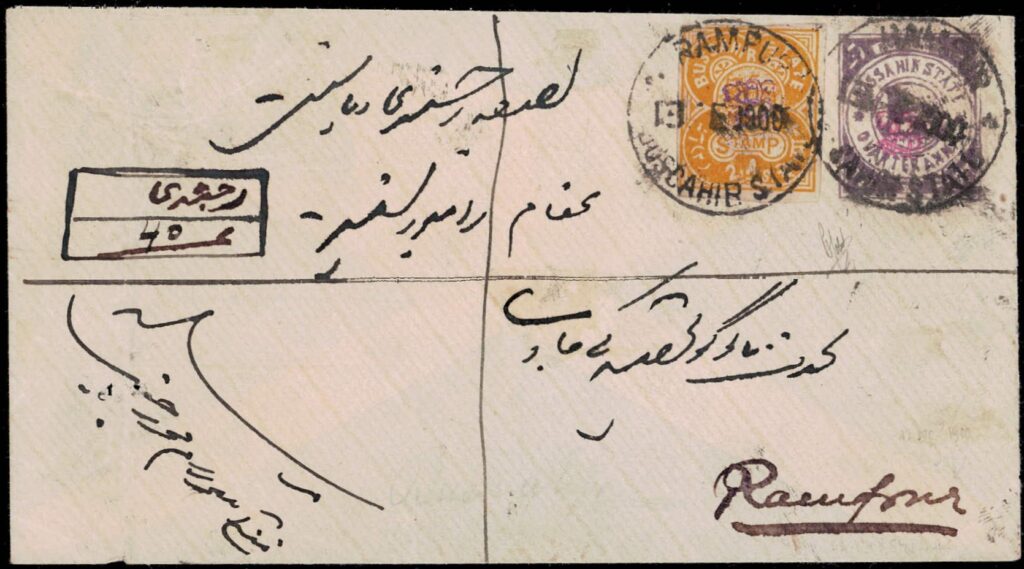
Bussahir ½ anna violet envelope with monogram in rose additionally franked with 2 anna orange-yellow with monogram in violet. Although the Ascher catalog mentioned an unused copy of this envelope, whereabouts of it are not known.
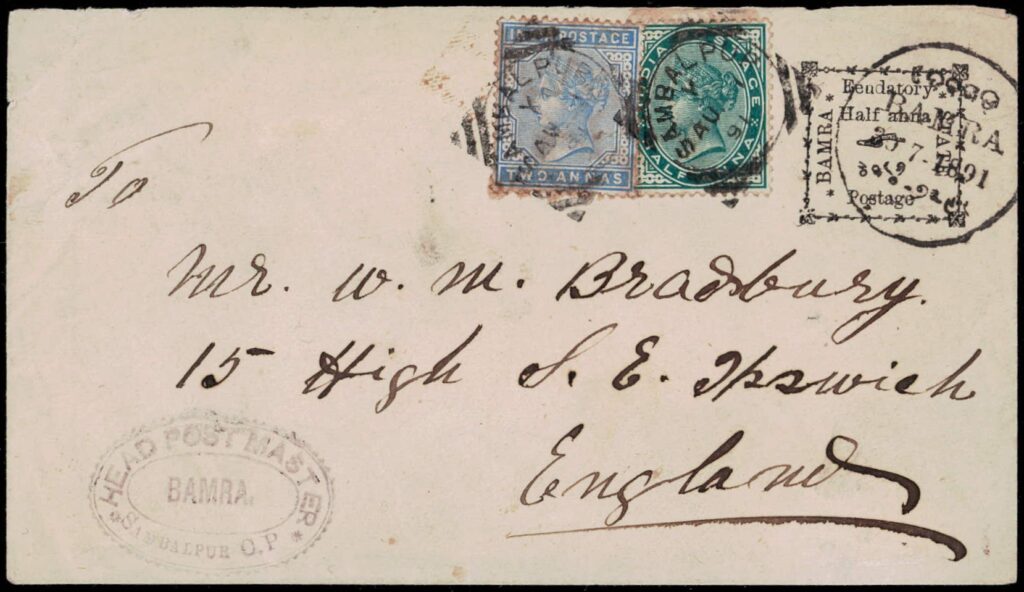
Bamra ½ anna envelope cancelled by Bamra state cds dated 30-7-1891 additionally franked with India ½ anna + 2 anna tied by “SAMBALPUR / AU 1 / 91” Imperial exchange post office cds with Bomby transit cds on reverse and “IPSWICH B / AU 24 / 91” delivery cds on reverse. The Bamra indicium paid for postage from the State to the Imperial post office in Sambalpur and the Indian stamps paid for the postage from Sambhapur to England. This is the only known example of a Bamra postal stationery sent to a foreign destination.