4 Nov 25 – British East Asia Postal Stationery
by Wayne Menuz FRPSL
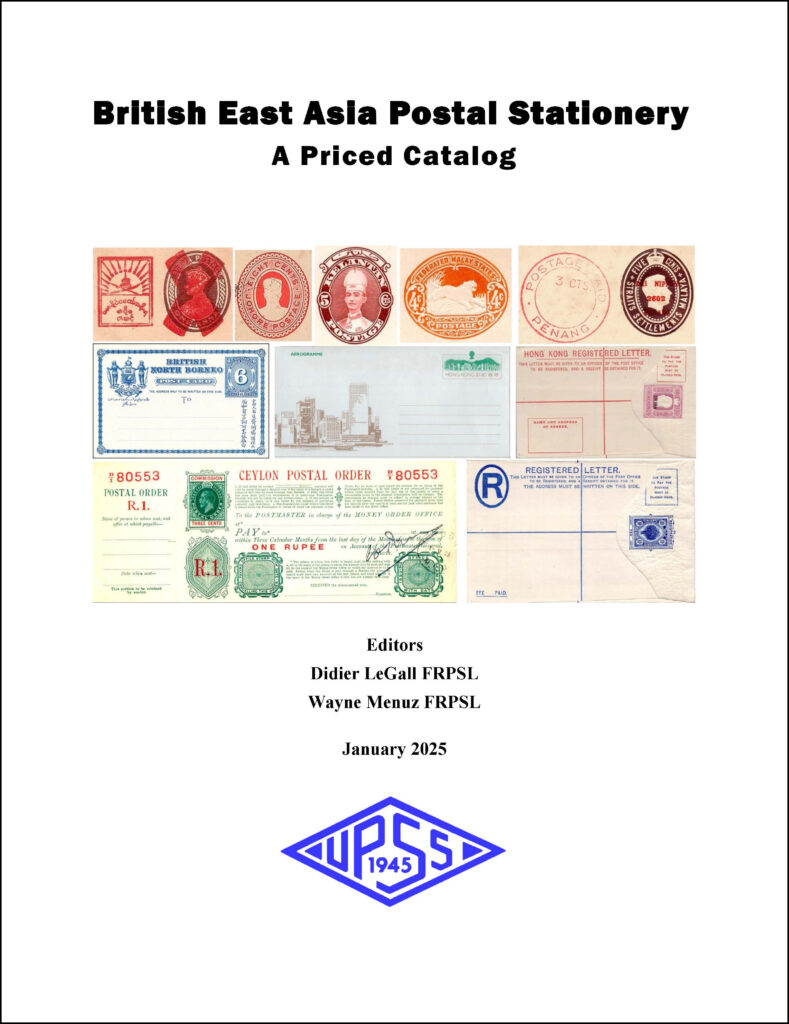
On Tuesday 4th November 2025, in a live meeting of the Royal Philatelic Society London Wayne Menuz FRPSL gave a presentation to an international audience of 80 people from 15 countries on the processes used by Wayne and his co-editor Didier LeGall FRPSL to create a new catalogue of the postal stationery of British East Asia, published in 2025 by the United Postal Stationery Society.

In 1971 I spent the summer between my junior and senior years at university working for Higgins & Gage. I was hired to inventory its stock of postal stationery. I had switched from collecting stamps to postal stationery 11 years before, so it was a dream job. I was intrigued observing Ed Fladung compose the ”S” countries section of the H&G catalogue. After Ed’s death Alec Gage sold the catalogue to Mel Feiner, who asked me to become editor of a new edition. Extensive worldwide travel for work, and now with a family, forced me to reluctantly decline to offer. As the years passed, the omissions and errors in the H&G catalogue were revealed, and of course, new issues since the 1970s are not included. Inflation and changes in collector interests made prices irrelevant. I accepted the editorship of “Postal Stationery”, the journal of the United Postal Stationery Society in 2001. The advent of the computer and scanners greatly facilitated creating illustrated pages for publications. Photoshop and other tools allowed critical examinations of rare postal stationery overprints listed in H&G and other catalogues. To my horror, most of these in my collection from many British Colonies were shown conclusively to be fake or bogus. These were revealed in a series of articles in the journal during the past decade.
A new catalog was needed. The area of the world most lacking a good postal stationery catalog encompasses most of the British Empire. A fellow collector, Didier LeGall, agreed to work with me on a project to fill the need. The most difficult area would be British East Asia, so we tackled that first.
He would drive the 30 minutes to my home three or four days a week, arriving about 9:00 am. We worked until dinner, and continued afterwards until about 9:00 pm. After two years, the 300 pages were finished.